
Legal search is competitive and expensive. A single click on a legal ad can cost a lot, which makes organic rankings especially valuable for law firms. I’m Anoob PT, founder of SEOBff, with 15+ years in SEO.
In this 2027 guide I cover the SEO strategies and tips that help law firms rank for high-value practice-area searches, build trust and bring in more cases.
What Is Lawyer SEO and Why It Matters
Lawyer SEO is the process of making a law firm’s website more visible on Google and other search engines so potential clients can easily find it. Think of it as placing your law firm’s signboard on the busiest street in town — but in the online world.
Today, most people who need legal help start with a quick Google search like “best divorce lawyer near me” or “corporate law firm in Mumbai.” If your website appears at the top, you have a much better chance of getting that client’s call.
Unlike traditional marketing such as print ads or billboards, SEO targets people already looking for legal services. This means higher-quality leads and better return on investment.
Benefits for different firm sizes:
- Small law firms: Can compete with big firms by ranking locally for niche legal services.
- Large firms: Can strengthen brand authority and dominate search results for multiple practice areas.
In short, lawyer SEO bridges the gap between your expertise and the clients who need it most — right when they’re searching
.
Why Local SEO Is Important for Law Firms
Local search connects people who need legal help right now with firms nearby. Showing up in Maps and the Local Pack means high-intent calls, stronger trust from reviews, and lower client-acquisition costs than ads. It’s the fastest path to measurable growth for law firm seo.
Step 1 – Create and Optimize Your Google Business Profile for Law Firms
Why GBP matters
- Your Google Business Profile powers Maps/Local Pack—prime real estate for search engine optimization for law firms.
- It influences calls, website visits, and directions with visible reviews, hours, and photos.
How to set it up (quick start)
- Go to google.com/business → “Manage now.”
- Enter firm name exactly as on your website (no keyword stuffing).
- Choose primary category: “Law firm” or your specific practice (e.g., “Personal injury attorney”).
- Add service areas (cities/ZIPs you serve).
- Verify (postcard, phone, or email).
- Add core details: hours, phone, website, appointment URL.
Optimize for conversions & ranking
7. Fill “Services” with practice areas (e.g., Divorce, Criminal Defense) and short descriptions.
8. Upload real photos: attorneys, office exterior/interior, team at work.
9. Publish weekly Posts: FAQs, case updates, new guides—great for seo law firm marketing.
10. Turn on Messaging; set a quick auto-reply.
11. Use Q&A: add common questions and answer them yourself.
12. Create a short review link and share after successful case closures.
13. Track clicks and calls using UTM tags—vital for seo analytics for law firms.
Pro tip: If working with the best seo agency for law firms, ask how they measure GBP actions vs. calls.
Step 2 – Make Your Law Firm Website “Local Friendly”
Must-do on-site actions
- Build one page per location + practice area (e.g., “Divorce Lawyer in Pune”).
- Place NAP (Name, Address, Phone) in header/footer; match GBP exactly.
- Embed a dynamic Google Map on Contact/Location pages.
- Add client testimonials and case outcomes (with consent).
- Use clear CTAs: “Call Now,” “Book Consultation,” sticky mobile call button.
- Improve mobile UX: readable fonts, tap-friendly buttons, fast forms.
- Add LocalBusiness/LegalService schema to reinforce law firm search engine optimization.
- Write entity-rich content and FAQs—smart semantic seo for law firms that matches how clients ask questions.
- Publish a pricing/fees explainer when possible—builds trust and reduces bounce.
- Include attorney bios with credentials to support E-E-A-T (experience, expertise, authority, trust).
Step 3 – List Your Law Firm on Local Directories (Citations)
Where to list first
- Legal: Avvo, Justia, FindLaw, Martindale-Hubbell, Super Lawyers, Lawyers.com, LegalZoom directory.
- General: Google, Bing Places, Yelp, Facebook, Apple Maps.
- Local/industry groups: Chamber of Commerce, bar association member pages.
How to do it right
- Keep NAP 100% consistent across all profiles.
- Use your primary category consistently.
- Add the same practice areas and descriptions you used on GBP.
- Upload identical branding (logo, photos).
- Monitor duplicates/suppress wrong listings (BrightLocal/Yext can help).
- Track referral traffic/leads from directories—proof for best seo services for law firms work.
Step 4 – Build Local Links & Earn Mentions
Simple link-building plays
- Join/local sponsor: Rotary, legal aid events, universities—ask for a website link.
- Offer scholarships or legal clinics; publish a press release on local news sites.
- Pitch guest posts to city blogs or practice-area publications (ethics-safe topics).
- Contribute expert quotes to journalists via HARO/Qwoted; earn high-authority mentions.
- Partner pages: accountants, realtors, medical clinics—mutual referrals + links.
- Publish original data (e.g., accident stats) to attract natural links.
- Repurpose guides into infographics/videos for extra embed-worthy assets.
Note: Many tactics mirror what the best seo companies for law firms do—cost-effective for small law firm seo too.
Step 5 – Ask for Reviews & Manage Online Reputation
Impact & platforms
- Reviews boost Local Pack rankings and conversions—central to best seo for lawyers outcomes.
- Focus on Google first; then Avvo, Facebook, and key legal directories.
How to request reviews (ethical, easy)
- Ask immediately after a positive outcome; share your short review link.
- Provide a 3-step instruction screenshot to simplify the process.
- Never offer compensation; follow bar rules.
- Rotate prompts: service quality, communication, clarity, results.
- Respond to every review within 48 hours—thank positives, resolve negatives politely.
- Showcase reviews on site with schema to enhance search engine optimization for lawyers.
Step 6 – Fix Basic Technical Issues for Lawyers’ Websites
Technical checklist (beginner-friendly)
- HTTPS everywhere (valid SSL).
- Mobile-first design; pass Core Web Vitals.
- Compress/resize images; enable caching/CDN.
- Fix broken links and 404s; add 301 redirects where needed.
- Generate XML sitemap; submit in Google Search Console.
- Clean robots.txt (don’t block important pages).
- Implement canonical tags to prevent duplicates.
- Add LocalBusiness/LegalService schema (address, hours, phones, reviews).
- Set up GA4 + GSC goals for calls, forms, chats—foundation for seo analytics for law firms.
- Track GBP calls and UTM-tagged clicks to blend Local + search engine marketing for lawyers insights.
Recommended Local SEO Tools for Law Firms
| Tool | Why It’s Used for Local SEO |
| Google Business Profile | Visibility in Maps/Local Pack; posts, reviews, Q&A, messaging. |
| BrightLocal / Yext | Build/fix citations, suppress duplicates, track local rankings and reviews. |
| Local Falcon | Grid-based heatmaps to see where your GBP ranks across neighborhoods. |
| Birdeye / Podium | Automate review requests, respond from one inbox, monitor reputation. |
On-Page SEO for Law Firms: Website Optimization Essentials
On-page SEO is like preparing your law office for clients before they arrive — everything should be easy to find, clearly labeled, and welcoming. For attorneys, strong on-page SEO ensures Google understands your expertise and matches you with people actively searching for legal help.
Keyword Research & Optimization
Tools to start with: Google Keyword Planner, Ubersuggest, SEMrush
- Search for terms potential clients actually use, like “personal injury lawyer Dallas” or “family law attorney NYC”.
- Note variations (singular/plural, “attorney” vs. “lawyer”).
- Place primary keywords in:
- Page title (H1)
- Subheadings (H2, H3)
- URL slug
- First 100 words of the page
- Image ALT text
- Page title (H1)
- Avoid keyword stuffing — aim for natural, helpful sentences.
High-Quality, Relevant Content
Steps:
- Create a dedicated page for each practice area and location you serve.
- Answer FAQs clients usually ask — about process, fees, timelines.
- Include case studies or anonymized client stories to build trust.
- Example page title: “Divorce Lawyer in Chicago – Expert Legal Assistance”.
- Update content regularly to keep it accurate and fresh.
Title Tags & Meta Descriptions
- Title Tag: Keep under 60 characters, include location + service. Example: Best Personal Injury Lawyer in Houston.
- Meta Description: Under 160 characters, summarize the page and invite clicks. Example: Get expert legal help from Houston’s trusted personal injury lawyers. Call today for a free consultation.
- Make it engaging — you’re competing for attention in search results.
Internal Linking & Navigation
- Link your practice area pages to related services (e.g., “Family Law” → “Child Custody” page).
- Include breadcrumb navigation so visitors always know where they are.
- Add links from blog posts to your main service pages.
- Use descriptive anchor text: instead of “click here,” write “learn more about our DUI defense services.”
Image Optimization & ALT Text
- Upload high-quality photos: attorney headshots, team photos, office images, event participation.
- Compress images before uploading to speed up load times.
- Add descriptive ALT text for each image. Example: Attorney consulting client in NYC office.
- Name image files clearly: divorce-lawyer-chicago.jpg instead of IMG0023.jpg.
URL Structure & Keyword Inclusion
- Keep URLs short and descriptive — avoid unnecessary numbers or symbols.
- Include both the service and location in the slug. Example: yourlawfirm.com/divorce-lawyer-nyc.
- Use hyphens between words (Google prefers this).
Mobile-Friendliness & Page Speed
- Test your site with Google’s Mobile-Friendly Test tool.
- Use Core Web Vitals in Google Search Console to identify speed issues.
- Compress images, enable browser caching, and choose fast hosting.
- Make buttons large enough for easy tapping on mobile devices.
Header Tags (H1, H2, H3)
- Use one H1 per page — this is your main headline.
- Use H2 for major sections like “Practice Areas” or “Why Choose Us.”
- Use H3 for subtopics, FAQs, or supporting points.
- Naturally include keywords in these headers when relevant.
Recommended On-Page SEO Tools for Law Firms
| Tool | Why It’s Used |
| Surfer SEO | Checks content score, keyword density, and heading structure. |
| Yoast SEO | Easy management of meta tags, XML sitemaps, and on-page SEO basics. |
| Google Keyword Planner | Finds high-volume, relevant legal search queries. |
| SEMrush | Optimizes content and identifies competitive legal keywords. |
Off-Page SEO for Law Firms: Building Authority
If on-page SEO is how you set up your law office, off-page SEO is how you build your reputation in the community. It’s about getting other reputable websites and online platforms to mention, link to, or recommend your firm — so Google sees you as trustworthy and authoritative.
Backlink Building from Reputable Sites
- Legal Directories: Add your firm to trusted directories like Avvo, Justia, and FindLaw.
- Local Partnerships: Collaborate with local businesses, charities, or universities to get featured on their websites.
- Bar Association Listings: Make sure your profile is complete and includes a link to your site.
- Aim for quality over quantity — one link from a respected legal site is worth more than dozens from low-quality blogs.
Social Media Marketing
- Post legal tips, recent case wins (if permitted), or client testimonials.
- Use hashtags like #LawyerMarketing and #AttorneySEO to reach broader audiences.
- Engage with comments and messages — social activity can indirectly boost SEO through brand awareness.
- Keep a consistent posting schedule to stay visible.
Guest Blogging & PR
- Write guest articles for reputable legal blogs or local news sites.
- Share insights on trending legal topics — this helps earn backlinks and build credibility.
- Collaborate with journalists via platforms like HARO (Help a Reporter Out) to get quoted in articles.
- Always include your author bio with a link to your website.
Brand Mentions Without Links
- Encourage clients, partners, and journalists to mention your firm online.
- Even without a clickable link, Google notices your name appearing on reputable sites.
- Track mentions with Google Alerts and ask webmasters to add links when possible.
Forum & Community Engagement
- Participate in relevant online discussions — Quora, Reddit’s r/legaladvice, and legal forums.
- Provide genuine, helpful answers without pushing your services too hard.
- Add value first — people will check your profile and visit your site naturally.
- Use your real name and firm to build trust.
Recommended Off-Page SEO Tools for Law Firms
| Tool | Why It’s Used |
| Ahrefs / SEMrush | Track backlinks, find competitor link sources, and monitor authority. |
| BuzzSumo | Discover influencers, trending content, and backlink opportunities. |
| BrightLocal | Manage local citations, check NAP consistency, monitor local rankings. |
| Google Alerts | Get notified when your brand is mentioned online for quick engagement. |
Technical SEO for Law Firms: Site Speed, Mobile & Structure
Think of technical SEO as the behind-the-scenes work that makes your law firm’s website run smoothly for both visitors and search engines. If your site is slow, hard to navigate, or insecure, potential clients — and Google — will move on.
Website Architecture & Crawlability
- Keep your site structure simple — think “homepage → practice area → sub-service page.”
- Use breadcrumb navigation so users and search engines can see where they are on your site.
- Avoid burying important pages too deep; no page should take more than 3 clicks to reach.
Robots.txt, XML Sitemap & HTTPS Security
- Robots.txt: Tells search engines which pages to crawl and which to ignore.
- XML Sitemap: Lists all important pages so Google can find them quickly.
- HTTPS: Install an SSL certificate so your site shows the secure padlock icon — critical for client trust.
Fixing Crawl Errors & Duplicate Content
- Use Google Search Console to find and fix “404 Not Found” pages.
- Add canonical tags if you have similar content across multiple pages.
- Merge or rewrite duplicate pages to avoid confusing search engines.
Structured Data (Schema Markup) for Law Firms
- Add LocalBusiness and LegalService schema to your site’s code.
- Include details like address, phone, practice areas, and reviews.
- This helps Google display rich snippets — like ratings and location — in search results.
Page Speed & Core Web Vitals
- Compress large images before uploading.
- Enable browser caching and use a reliable hosting provider.
- Minimize unnecessary scripts and plugins.
- Check your site’s performance with Google PageSpeed Insights and fix any flagged issues.
Recommended Technical SEO Tools for Law Firms
| Tool | Why It’s Used |
| Google Search Console | Monitor indexing, crawl issues, and mobile usability. |
| Screaming Frog | Audit site structure and find technical errors. |
| GTmetrix | Analyze site speed and get improvement tips. |
| Schema Markup Generator | Create and test legal service schema easily. |
| NitroPack / WP Rocket | Boost site speed through caching and optimization. |
3 Real-Time Examples of SEO Success for Law Firms
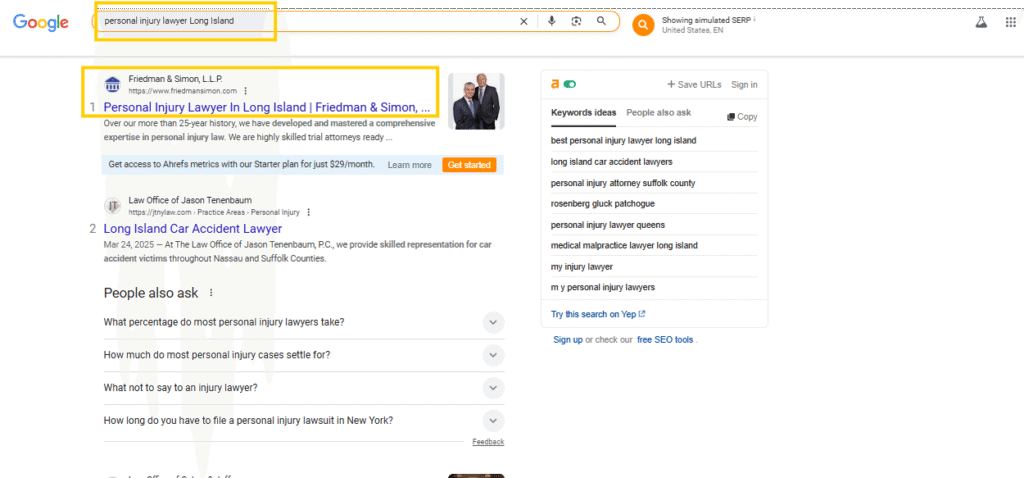
1. Friedman & Simon, LLP – New York
- Challenge: The firm struggled with visibility for local personal injury keywords.
- SEO Strategy: Optimized Google Business Profile, built location-specific landing pages, and earned backlinks from local news outlets.
- Results: Within 8 months, their “personal injury lawyer Long Island” keyword ranked in the top 3 on Google, leading to a 300% increase in inbound calls.
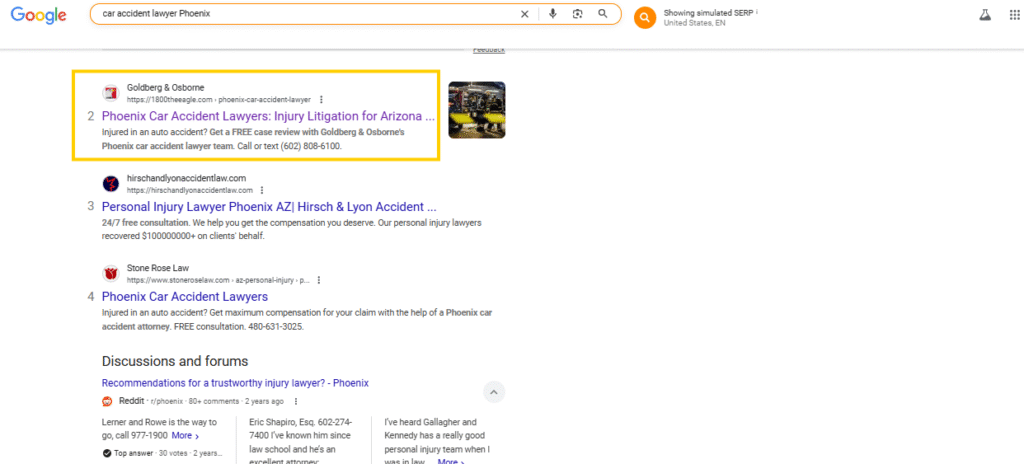
2. Goldberg & Osborne
- Challenge: Competitive personal injury market with large PPC spends but low organic leads.
- SEO Strategy: Focused on long-tail keywords (“car accident lawyer Phoenix”), implemented technical SEO fixes, and published high-authority legal guides.
- Results: Organic traffic increased by 120,000+ monthly visitors, and organic leads rose by 40% year-over-year.
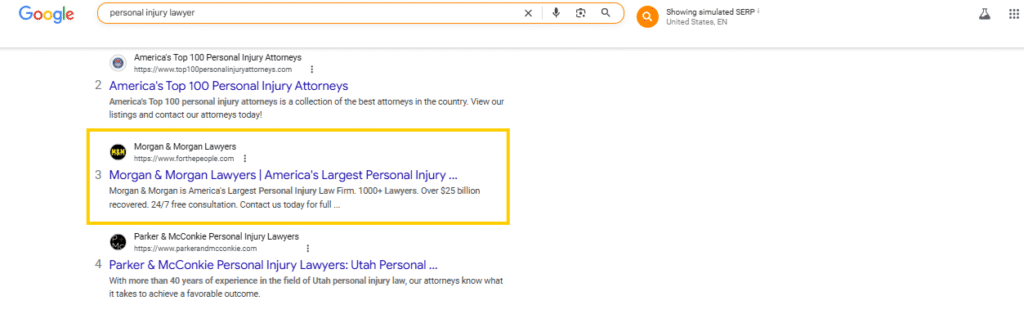
3. Morgan & Morgan – National Law Firm
- Challenge: Needed to dominate national SERPs for high-value personal injury keywords.
- SEO Strategy: Built hundreds of localized service pages, invested in aggressive link-building, and optimized site speed and schema markup.
- Results: Now ranks third on the first page for “personal injury lawyer” in multiple states, contributing to thousands of new client intakes each month.
Conclusion – Power Up Your Law Firm with SEO
From Local SEO that gets your firm listed in “near me” searches, to On-Page SEO that optimizes your website’s structure and content, Off-Page SEO that builds credibility through quality backlinks, and Technical SEO that ensures fast, secure, and mobile-friendly performance — every strategy plays a role in growing your law firm’s online presence.
The sooner you begin, the faster you can outrank competitors and claim a top spot in search results. SEO is not a one-time task but an investment that compounds over time, steadily increasing your client base and brand visibility. In a competitive legal market, waiting means giving others the chance to capture the clients you could have had. Start now, and let SEO work as your 24/7 client acquisition engine.
Related reading: SEO for Solicitors: Boost Rankings, Grow Leads & Build Trust [2027], SEO for Doctors: How to Attract More Patients Online [2027], SEO for the Healthcare Industry: 10+ Proven Strategies for 2027.