I have a slightly unusual angle on this Writesonic review. Before I started SEOBff, I was Head of Marketing at Writesonic. I sat in roadmap discussions with the product team, worked with the content and growth teams on positioning, and spent a lot of time talking to customers about what they actually needed from an AI tool.
So I know how the product is built, why certain decisions were made, and where the gaps tend to show up. I no longer work there and nobody paid for this post. What follows is my honest take on Writesonic as it stands in late 2026, mixed with what real users say about it.
Writesonic review at a glance
Writesonic is an all-in-one platform for AI search visibility (GEO/AEO), SEO workflows and AI content generation. It suits SEO-focused marketers and teams more than anyone wanting hands-off, publish-ready copy: great for fast drafts and tracking brand mentions in AI answers, but long-form drafts need editing and key visibility features sit on higher tiers.
- Key strength, AI search visibility: tracks brand mentions, sentiment, citations and visibility across ChatGPT, Perplexity, Gemini and Google AI Overviews.
- Key strength, SEO and content in one workflow: keyword research, topic clusters, site audits and optimization bundled with the Article Writer and Chatsonic.
- Key strength, speed and ease of use: outlines, short-form copy and first drafts come together quickly in a structured workflow.
- Drawback, editing required: long-form articles can feel formulaic without human editing, fact-checking and good prompts.
- Drawback, feature gating: core AI visibility tools sit on higher-priced plans, and advanced features cost more.
- Drawback, occasional hiccups: some reviewers report generation failures, formatting limits and few deep BI or enterprise integrations.
- What users say: broadly positive on G2 (4.7/5), Capterra (4.8/5) and Trustpilot (4.6/5) for speed and convenience, with cost and editing as the common caveats.
Writesonic at a glance
| Detail | Writesonic |
|---|---|
| What it is | AI search visibility (GEO/AEO) platform with an AI SEO writer and site audits |
| Founder | Samanyou Garg |
| Best for | In-house marketing teams and agencies that want AI visibility tracking and content in one tool |
| AI platforms tracked | ChatGPT, Gemini and Google AI Overviews on self-serve plans; up to 10 platforms on Enterprise |
| Starting price | $79/month billed annually (Starter); about $99 billed monthly |
| Free trial | Yes, 7 days on Starter, Basic and Growth |
| Standout features | Brand Explorer, Action Center, AI bot analytics, citation tracking, Article Writer |
| User ratings | G2 4.7/5, Capterra 4.8/5, Trustpilot 4.6/5 (5,700+ reviews) |
| My rating | 4.0/5: strong product, but you need a skilled operator to turn data into results |
What is Writesonic?
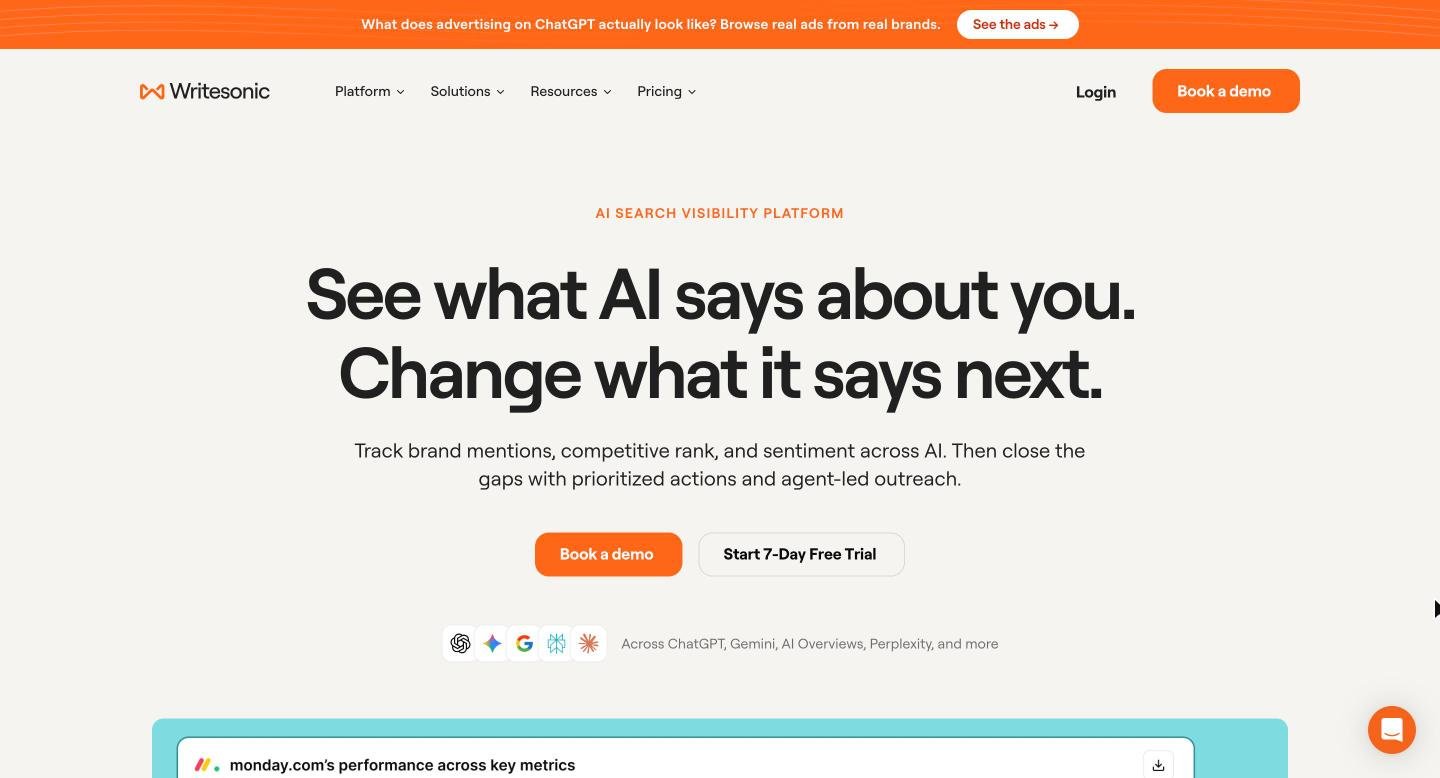
Writesonic started life as an AI writing tool. Most people still remember it for blog posts, ad copy and Chatsonic, its ChatGPT-style assistant. Over the last two years the company has changed direction, and today it sells itself as an AI search visibility platform. The homepage headline says it plainly: see what AI says about you, then change what it says next.
In practice the platform now has three layers. The first is tracking: it runs your prompts through AI engines such as ChatGPT, Gemini and Google AI Overviews and records whether your brand is mentioned, cited and recommended. The second is action: an Action Center turns visibility gaps into tasks, and agents help with content, citation outreach and Reddit replies. The third is the original content engine, now an SEO and GEO writer with site audits attached.
From my time on the inside, this shift made sense. Customers were asking a new question. It was no longer “can you write my blog post?” but “why does ChatGPT recommend my competitor and not me?” Writesonic moved early to answer that question, and it shows in how much the product has grown.
Who is Writesonic best for?
- In-house marketing teams that want AI visibility tracking and content production in a single subscription.
- SEO and content agencies that manage several brands and need white-label reporting on AI search.
- SaaS and ecommerce brands that already publish a lot of content and want to know which pages AI engines cite.
- Teams that are new to GEO and want guided recommendations rather than a raw data dashboard.
It is a weaker fit for solo bloggers who only need a cheap writing assistant, and for enterprise teams that need every AI engine, SSO and strict compliance on day one, because those sit behind the Enterprise plan.
Writesonic features
AI visibility tracking and Brand Explorer
This is now the core of the product. You add prompts that matter to your business, and Writesonic tracks mentions, share of voice, citations and competitor rank across AI engines. Brand Explorer adds a wider view, drawn from what Writesonic says are more than 2 billion AI conversations, so you can find prompts where your brand shows up that you never thought to track.
Action Center
The Action Center ranks visibility gaps by impact and suggests what to do next, for example a page to update, a publication to pitch or a comparison article to write. It is the feature that most clearly separates Writesonic from pure trackers. My honest view: the suggestions are a good starting list, but some are high-effort and some are generic. Someone with real SEO judgment still has to decide which ones are worth doing.
Citation and page tracking
You can see which of your URLs AI engines cite, group pages into portfolios, and spot which third-party sites are cited for your topics. That last part is gold for digital PR, because it tells you exactly where to earn a mention.
Sentiment analysis
On the Growth plan and above, Writesonic shows how AI engines describe your brand, including themes and competitor comparisons. This matters more than many teams realise. Being mentioned is not enough if the AI keeps calling you “expensive” or “hard to use”.
AI bot traffic analytics
Through a WordPress plugin or other integrations, Writesonic shows which AI crawlers visit your site and which pages they read. It is a useful technical signal that most traditional SEO tools still do not cover well.
Article Writer and SEO tools
The content side is still strong. The Article Writer follows a multi-step workflow with research, outlines, brand voice and a humanizer, and site audits flag technical SEO issues with suggested fixes. It connects to Google Analytics and Search Console, so content and visibility data live in one place.
Agents and Chatsonic
Agents handle repetitive jobs such as drafting outreach emails to authors, writing Reddit and community replies, and applying audit fixes. Chatsonic, the chat assistant, is still part of the package, although it is no longer the headline product.
Writesonic pricing
Writesonic has reworked its pricing around AI visibility. Here is the current structure from its pricing page in November 2026. Monthly-billed prices are approximate, based on the annual discount Writesonic lists.
| Plan | Billed annually | Billed monthly | Key inclusions |
|---|---|---|---|
| Starter | $79/mo | ~$99/mo | 50 prompts, 3 AI platforms, 15 AI articles, 1 user, AI bot analytics |
| Basic | $199/mo | ~$249/mo | 100 prompts, 3 AI platforms, 25 articles, 20 site audits, 2 users |
| Growth (most popular) | $399/mo | ~$499/mo | 200 prompts, sentiment analysis, Action Center trial, 50 articles, 3 users, 2 projects |
| Enterprise | Custom | Custom | All 10 AI platforms, custom prompts and regions, full Action Center, Outreach Agent, SSO, SOC 2 Type II, dedicated strategist |
All self-serve plans include a 7-day free trial and AI bot analytics. Sentiment analysis starts on Growth. SSO, SOC 2 Type II, all 10 AI platforms and a dedicated AI search strategist are Enterprise only. If you need to track Perplexity, Claude or other engines beyond the three default ones, budget for a sales conversation.
Writesonic pros
- One platform for tracking, recommendations and content, so you are not stitching together four tools.
- The Action Center turns data into a to-do list, which helps teams that are new to GEO.
- Citation tracking clearly shows which third-party sites influence AI answers in your niche.
- Easy to learn. The interface is friendly for marketers who are not SEO specialists.
- A fast-moving product team. Features ship quickly, and bugs are usually fixed fast.
- Strong content workflow with brand voice, research and SEO checks built in.
Writesonic cons
- Only three AI platforms on self-serve plans; wider coverage needs Enterprise.
- Sentiment analysis is locked to Growth and above, which is where the price jumps to $399+ per month.
- Action Center suggestions can be generic or hard to execute without SEO experience.
- AI-written articles still need a careful human edit for accuracy, quotes and tone.
- Billing and cancellation complaints come up often in reviews, especially on annual plans.
- Navigation can feel crowded now that content, SEO and GEO features all sit in one app.
- Occasional generation failures and formatting limits, and few deep integrations with BI or enterprise tools.
Writesonic reviews from real users
Writesonic has thousands of reviews across G2, Capterra and Trustpilot, and the overall scores are high. Still, I always read the extremes. Here are two positive and two negative reviews from Trustpilot that sum up the common themes.
Positive reviews
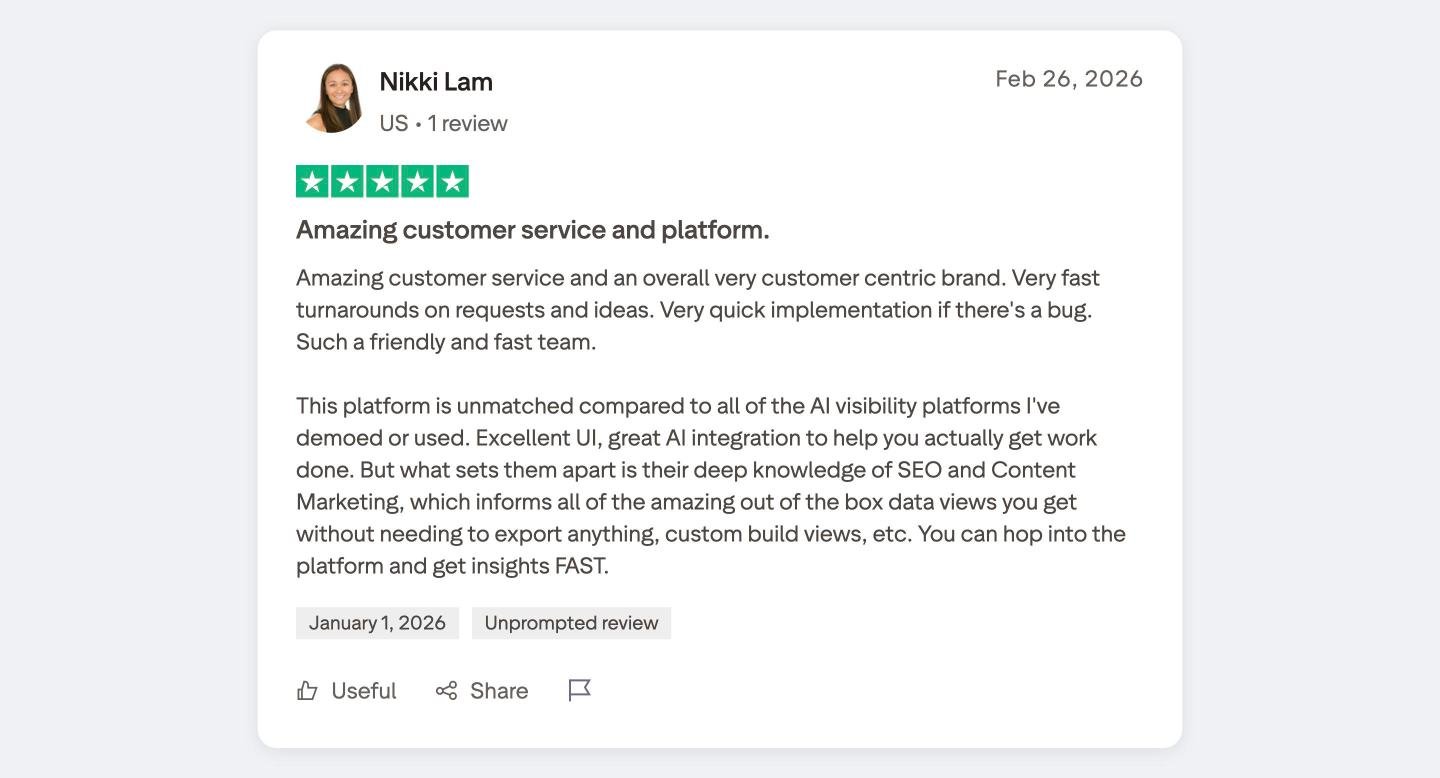
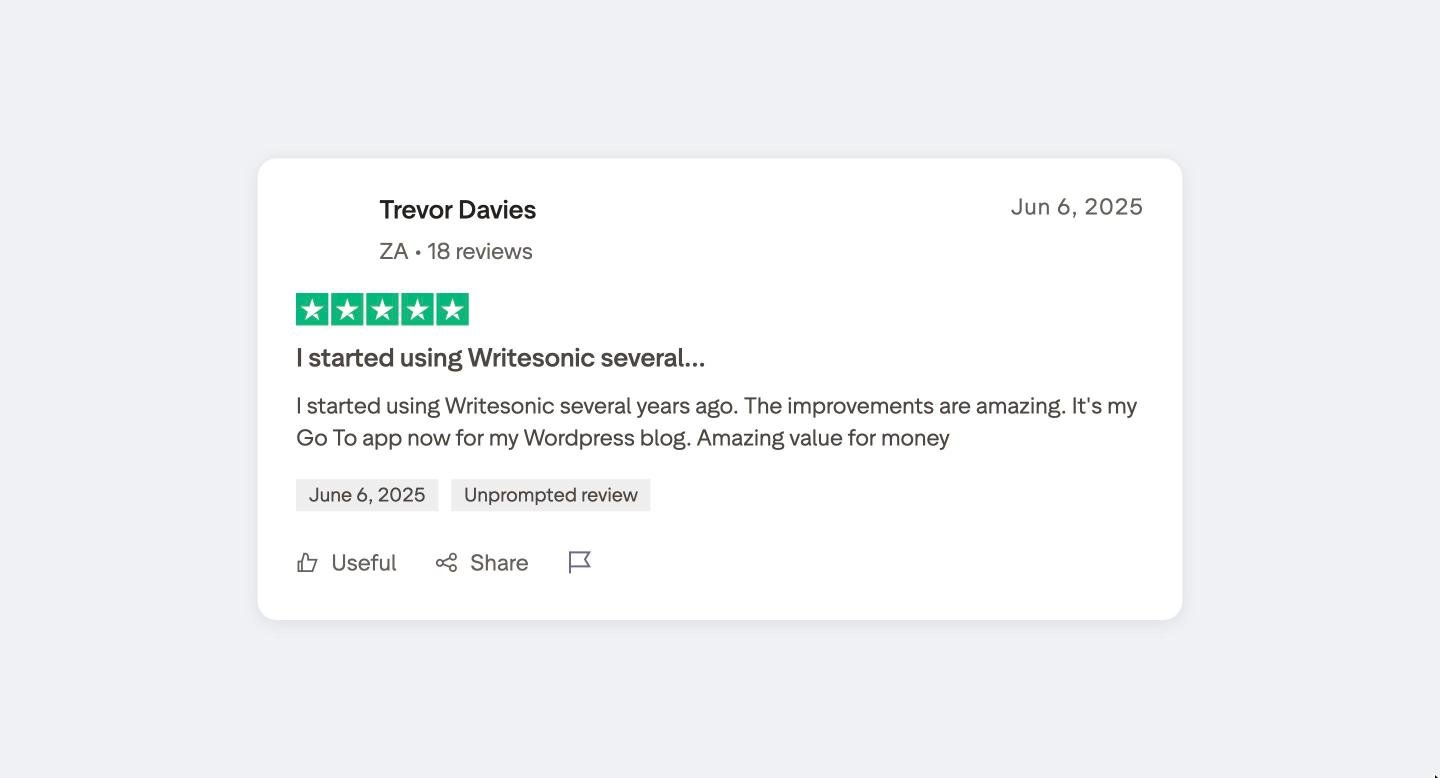
The praise lines up with what I saw from the inside: a responsive team, quick bug fixes, and a product that has improved a lot for people who have used it for years.
Negative reviews
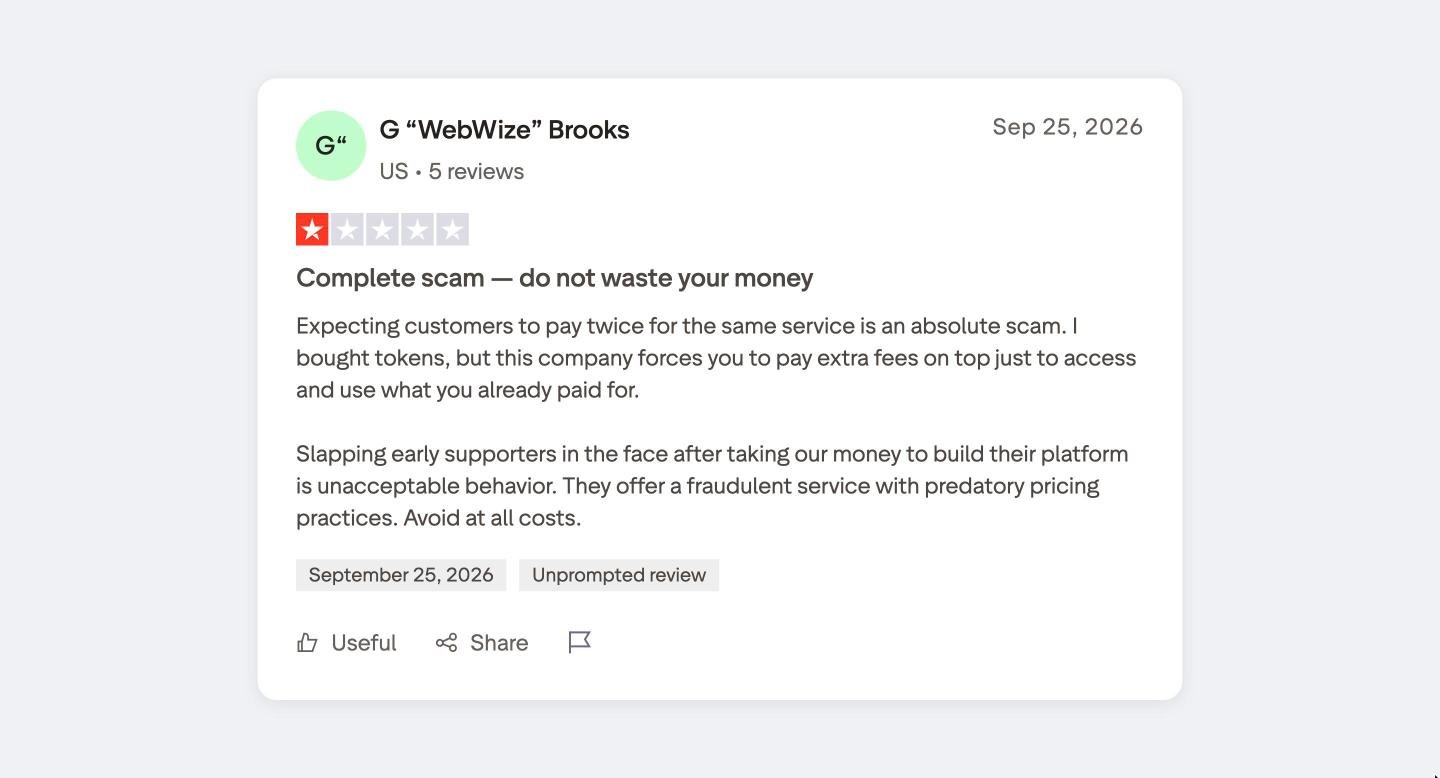
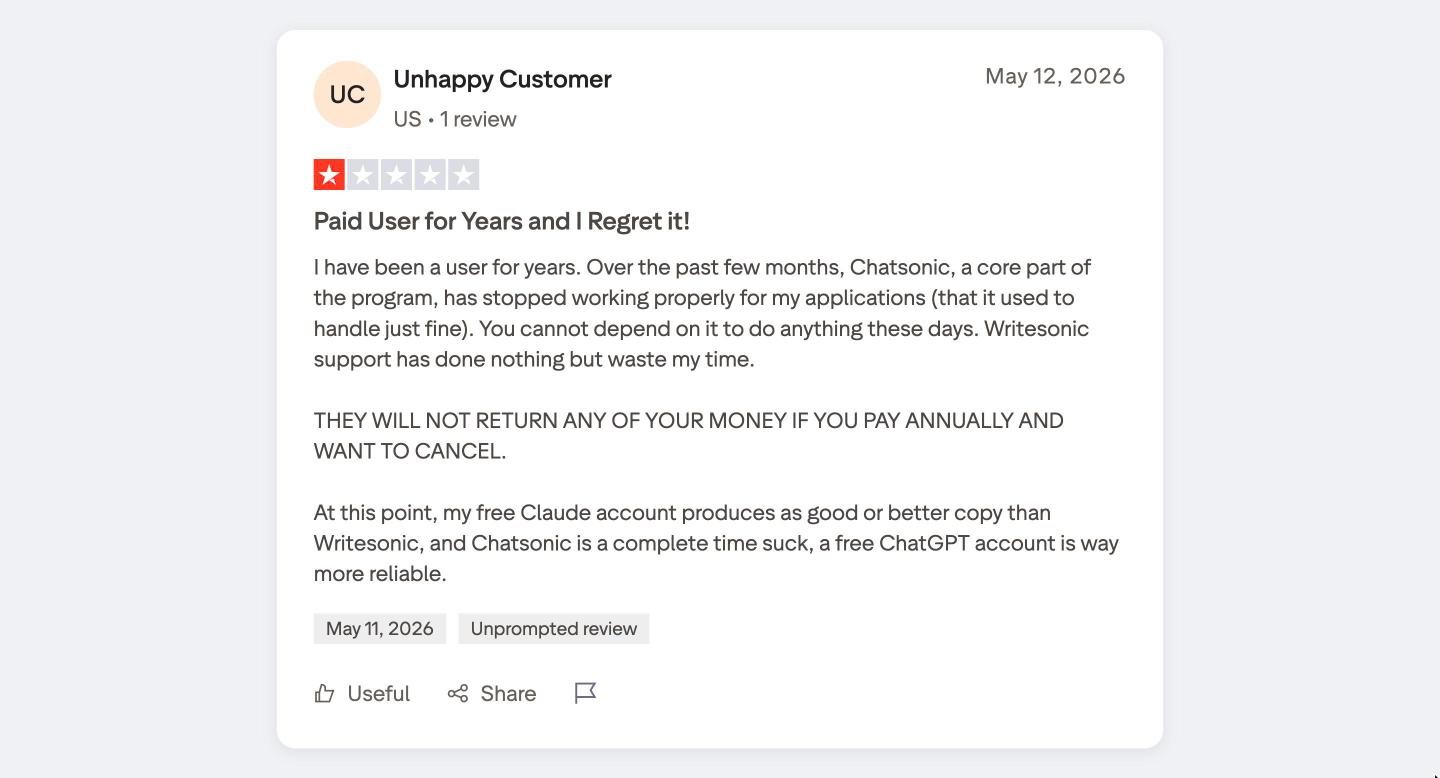
The complaints are mostly about pricing changes, cancellations and refunds, plus some frustration from long-time Chatsonic users as the company shifted focus to AI visibility. If you sign up, start on monthly billing, test properly during the trial, and read the refund terms before committing to an annual plan.
Writesonic alternatives
Writesonic is only one of many GEO tools. If it does not fit your budget or workflow, these are the alternatives I would look at. For a deeper comparison, see my full list of the best generative engine optimization tools.
| Tool | Best for |
|---|---|
| Peec AI | Marketing teams that want clean, fast AI visibility tracking across many markets and languages without a heavy setup. |
| Profound | Enterprise brands that need deep prompt-level data, conversation insights and strict security reviews. |
| Ahrefs Brand Radar | SEO teams already living in Ahrefs who want AI mentions sitting next to backlinks and organic data. |
| Semrush AI Visibility Toolkit | Teams on Semrush that want AI visibility added to an existing SEO workflow and reporting stack. |
| Otterly.AI | Small businesses and consultants who need affordable prompt monitoring and simple reports. |
| Scrunch AI | Large brands that care about how AI agents read and represent their site, not just mentions. |
| AthenaHQ | Growth-stage companies that want visibility tracking with built-in content recommendations. |
Final verdict: Is Writesonic worth it?
Writesonic is a capable platform, and I say that knowing exactly how much work went into it. If you want tracking, recommendations and content in one place, and you are happy with three AI engines to start, it is a solid choice.
But here is the bigger truth after 15 years in SEO and a front-row seat inside an AI SEO company: GEO tools are plentiful now. Writesonic, Peec AI, Profound, Ahrefs, Semrush and a dozen others will all tell you where you show up in AI answers. None of them will get you cited on their own. The results come from the person using the tool: how they pick prompts, which gaps they prioritise, how they rewrite pages, and where they earn mentions.
That is the work we do at SEOBff. We pick the right GEO tool stack for each brand, often a Writesonic alternative that suits the budget better, and turn the data into rankings, citations and pipeline. If you want that done for you, take a look at our generative engine optimization service.
Frequently asked questions
Is Writesonic worth it in 2026?
Writesonic is worth it if you want AI visibility tracking, recommendations and content creation in one tool and are comfortable starting with ChatGPT, Gemini and Google AI Overviews. Teams that need every AI engine or enterprise security will need the Enterprise plan or an alternative.
How much does Writesonic cost?
Writesonic starts at $79 per month billed annually for the Starter plan. Basic is $199 and Growth is $399 per month billed annually, with higher prices on monthly billing. Enterprise pricing is custom.
Does Writesonic have a free trial?
Yes. Writesonic offers a 7-day free trial on its Starter, Basic and Growth plans. Enterprise customers book a demo instead.
Which AI platforms does Writesonic track?
Self-serve plans track ChatGPT, Gemini and Google AI Overviews. The Enterprise plan covers up to 10 AI platforms, including engines such as Perplexity, Claude, Grok, DeepSeek and Meta AI.
What are the best Writesonic alternatives?
Popular Writesonic alternatives include Peec AI, Profound, Ahrefs Brand Radar, the Semrush AI Visibility Toolkit, Otterly.AI, Scrunch AI and AthenaHQ. The right choice depends on your budget, the AI engines you need and the SEO tools you already use.
Is Writesonic better than ChatGPT?
For SEO and GEO work, yes. Writesonic adds AI visibility tracking, site audits, keyword research and a structured article workflow on top of the underlying AI models. For general chat and one-off writing, ChatGPT is cheaper and often just as good.
Is Writesonic free to use?
You can start free with limited SEO and AI content tools, and paid plans come with a 7-day free trial. AI search visibility (GEO) features need a paid plan, starting at $79 per month billed annually.
Is Writesonic good for SEO content?
Writesonic produces solid first drafts with research, brand voice and SEO checks built in, but articles still need a careful human edit for accuracy, quotes and tone before publishing.